
The budget looks like Greek: billions exist, but there is no money for pensions
We pay taxes every month. We are working now, and in a few years we will retire. And I am not sure I will have a normal pension. I don't want to live in old age with the fear that I will end up in poverty.
Every morning, on my way to work, I walk over piles of garbage in the center of Netanya.
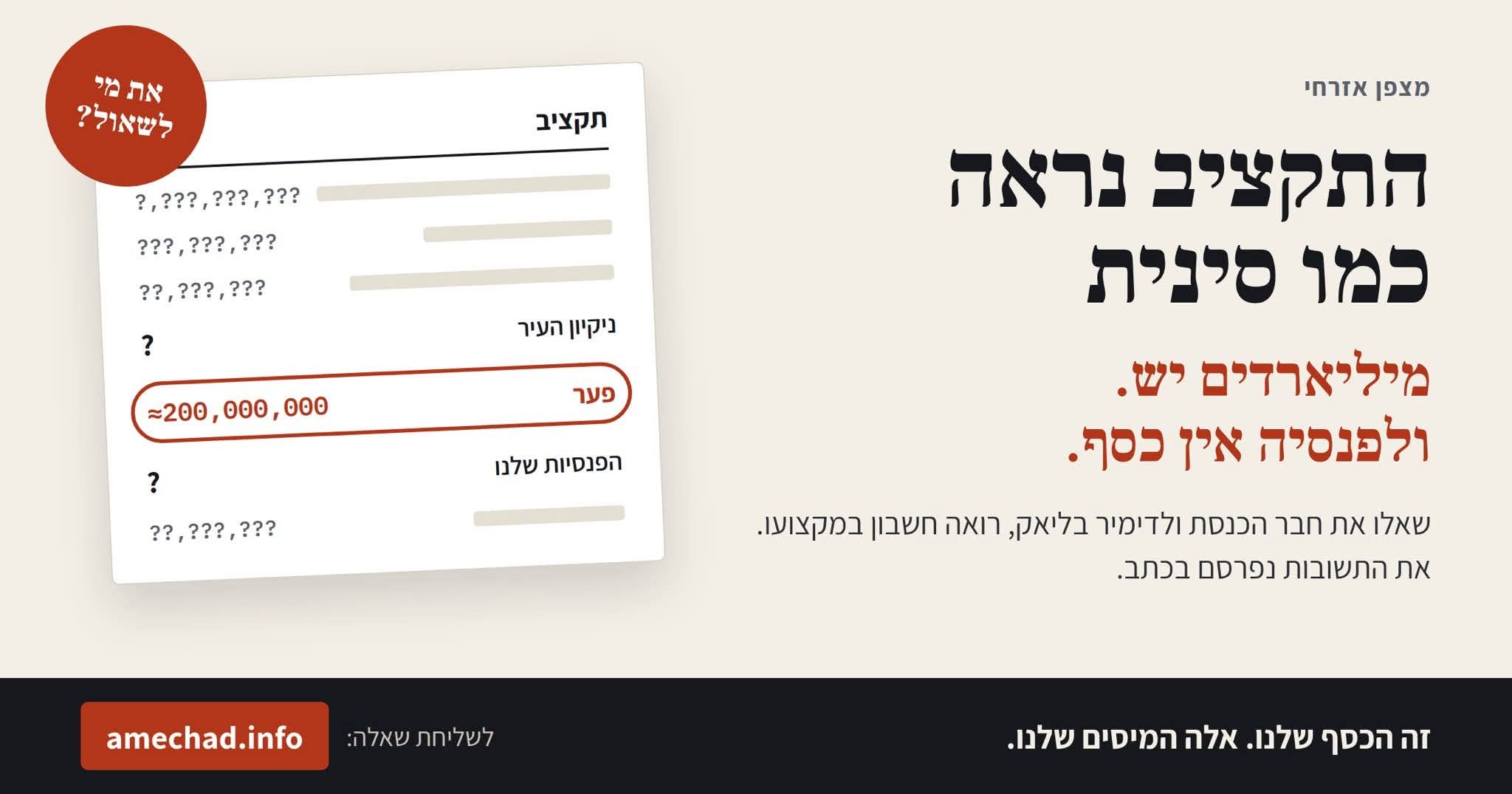
And then a volunteer of ours found a gap of about 200 million shekels in the municipal budget. We asked the mayor. And it turned out there was no one to ask.
Maybe this money should have gone, for example, to city cleanliness? We don't know. No one explained it to us.
That's usually how it is: there's no one to ask. And public officials often simply say: we don't have to answer you.
That is why it is very good that Knesset Member Vladimir Beliak (Be Yahad) is coming to us and is ready to answer citizens. By profession he is an accountant, and in the Knesset he is a member of the Finance Committee. Therefore, what is most important for us to ask him are questions about money: how much we pay, where it goes, and what we get in return. In simple and clear language.
And it is important to know: for the first time in Israel's history, Members of Knesset are writing a written report to citizens about their work. Not a Facebook post, not a news interview, but an organized report that anyone can sit down and read.
You don't need to search the networks for what the MK said. You don't need to guess whether he answered or not. Everything is in one place: the report, your questions, and his answers. You ask openly and get an answer openly.
Vladimir Beliak's annual report is already on the "Civil Compass" website. The report that he wrote himself, not our assessment.
Democracy is not supposed to end on election day.
Even after the elections, we will return to Vladimir Beliak and ask for explanations. Because through the budget, you can understand the most important thing: whether the public officials kept their promises or not. Promising is easy. What the money was spent on can be seen in the numbers.
We, the citizens, usually don't see it. Politicians find it very convenient to pit us against each other. We argue, fight, divide into "ours" and "theirs," and no one asks about the money. But public officials must answer to the citizens. We, the citizens, pay their salary.
And to this day, there are fewer Jews in the world than on the eve of World War II. We don't need to fight; we need to reach agreements. And one of the most straightforward ways to check if public officials are keeping their word is to see what they are spending our money on.
In Barcelona, residents decide for themselves what to spend part of the city budget on. And whoever chooses for themselves where the city's money will go will think twice before throwing trash on the sidewalk. Because they understand: more dirt means more cleaning workers, and the one who pays for them is them.
When the budget is clear, the citizen becomes the master of the house.
Therefore, I ask you:
1. Read Vladimir Beliak's report.
2. Send him a question through our platform.
3. Come to the meeting.
We will forward all questions received through the platform to the MK, and after the meeting, we will publish the answers in writing.
It doesn't matter who you vote for. "Civil Compass" is not a party platform. Taxes, pensions, children, parents, and clean streets affect everyone.
Don't settle for the numbers. Ask what stands behind them.
This is our money. Set a reminder: on 27.10 we go to vote.
Dr. Gutnik, Civil Compass
To read the report and send a question: https://www.amechad.info/knesset/bt21e7j0w4z6p6cf7aij2uis/
To register for the meeting: