
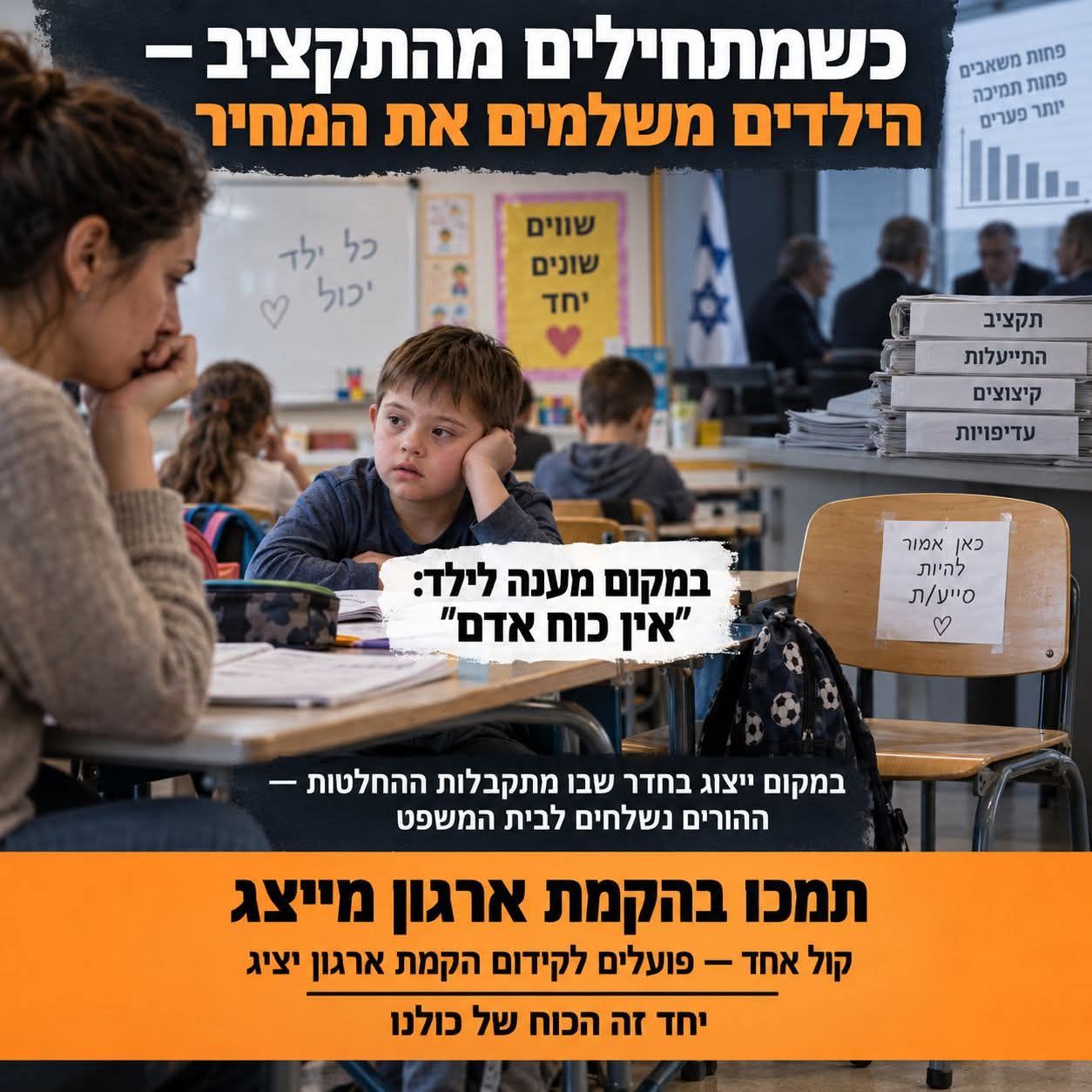
When you start with the budget, children with special needs pay the price
The Ministry of Education determines the budget, the salary levels, and the pricing of special education services, and only afterwards tries to squeeze the children's needs into that framework.
And that is where the problem begins.
When a child with special needs is included in a classroom (regular or special education), the first step should be to analyze their needs and determine what assistance they truly require.
Yet even after the need has been determined, parents hear the same answer over and over again:
"There is no manpower."
However, in many cases, the real problem is not that there are no people available to do the job, but rather that there are not enough people willing to do such an important and responsible job for the wages and conditions set for it.
This is the result of a backwards system.
Instead of starting with the child and their needs, the system starts with the budget. Afterwards, it tries to fit the services, the manpower, and the salary levels to that budget.
And when the financial framework falls short, it is the child who is left without the response they were determined to need.
The system must be turned around.
First, identify the child's true need.
Then, examine what is required to actually provide it and what the realistic market pricing is, and only at the end build the budget that makes it possible to provide the response.
But for this to happen, people with disabilities and parents of children with disabilities must be inside the decision-making rooms, not arriving after everything has already been decided.
And this is precisely where the need for a representative organization comes in.
The right to sit on these committees by law is reserved exclusively for representative organizations—a right not granted to just any non-profit or other organization that is not authorized to sit there and at most sends a letter, a position paper, or is invited to a conversation after the decision has already been made and its opposition has been "noted."
This is the true meaning of a representative organization: no longer a body that begs to be invited to a discussion, but a body whose status grants it the right to be in the room where decisions concerning the public it represents are made.
Without such representation, budgets, wages, services, and solutions continue to be determined for us—about us, without us.
Instead of representation in the room where decisions are made, parents are sent to court.
And a parent fighting for the support their child needs is frequently left with a terrifyingly expensive, exhausting, and lengthy legal process, just to receive what should have been provided in the first place.
If you are a parent of a child with special needs, this struggle directly concerns you.
Support the establishment of a representative organization. Read about our initiative, sign the support form, and help us advance this cause. kol1.org.il
One Voice — Working to advance the establishment of a representative organization
Together is the power of us all.